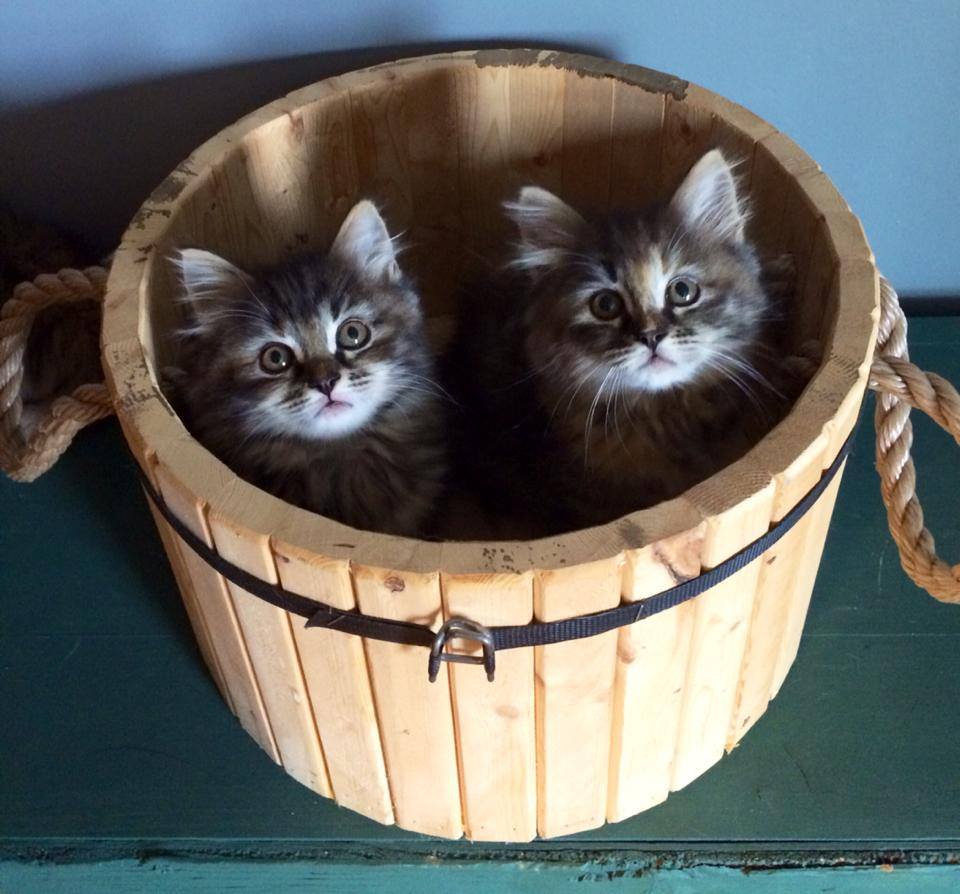
SIBERIAN KITTENS FOR SALE - RUSSIAN
RAINBOW OF
RARE COLORS.
HYPO-ALLERGENIC SIBERIAN CATS.
TRADITIONAL BROWN TABBIES,
TORBIES, TORTIES (CALICO).
DILUTES, REDS, VAN BICOLORS, SILVER CLASSIC & MACKEREL MARKINGS.
RARE SOLIDS, BLACK, BLUE,
GOLDENS, BLACK & BLUE SMOKES, SOLID WHITE.
COLORPOINTS AVAILABLE

SEAL, BLUE, RED & TORBIE POINTS, SOME WITH WHITE.
History
Characteristics
Breed Standard
Other Forest Cats
About Croshka
Guestbook
HISTORY OF THE SIBERIAN FOREST CAT
Written by Kathy Wade
An ancient long-haired breed now popular in the United
States is far from new to the Asian continent and
Europe. This breed was thought to be a combination
of all modern long-haired cats including both the Angora
and the Persian. The Siberian Forest Cat is
sometimes referred to as simply the "Siberian Cat" or
the "Siberia". In Germany it is known as the "Sibirische Katze".
Siberians were common cats roaming the Russian markets and the countryside of their homeland of Siberia.
Russian immigrants were said to have carried this breed with them as they journeyed to cold Moscow and St. Petersburg leaving the cold inhospitable climate of the North.
The breed continued to survive the harsh winters and climate and developed a thick fur and waterproof, oily coat.
During this time no one bothered to develop the Siberian into a pedigreed cat.
Russia did not allow citizens to own any kind of household pet, pedigreed or otherwise, because of the food shortage.
|
 PHOTO COMING SOON!
Windrifter Kremlin of Croshka,
red lynx point with
white. |

Svet Onyx Gloria of Chroshka, golden
mackerel tabby. TICA Award of Excellence, 2001/2002. |

El-Magrib Mephodiy of Croshka, seal point with white. Second Best New Breed Color Cat TICA Show,
Atlanta, Georgia, April 2001. |

El-Magrib Shagane of Croshka, female blue
lynx point, 5 months old. |
The largest domestic cat that has it all is here!!
The breed has been in the United States since 1990 and is quickly gaining popularity.
These
beautiful cats were brought here by Elizabeth Terrell of Starpoint Cattery.
The Russians
and Mrs. Terrell traded two breeds that were not found in either country.
The Russians
wanted some of our Himalayans and Elizabeth wanted the Siberian cat. The trade finally
happened after years of communication between the two.
Many stories have been told about this breed which we are not sure are true
today. The Siberian Cats first appeared in recorded history in the
year 1000. The breed as it spread throughout Europe, was noted in
Harrison Weir's late nineteenth century book, "Our Cats and All About Them",
as one of the three longhairs represented at the first cat show held in
England in the 1700's.
|
|
Also in Russian folklore these magnificent cats made their homes in Russian monasteries.
In the monasteries they would walk along the high beams and use their speed, strength, and agility.
The Siberians would be on the lookout for intruders, and yet show the monks loyal and loving companionship.
The Siberian is also Russia's native cat. With all of this information we all can see that it is not a new breed to Europe.
In later years after the end of the cold war in Russia, cat clubs became fashionable, and citizens were allowed to own pets.
Many cat clubs developed and one is St. Petersburg Kotofei (pronounced
COT-ah-fay), which is a division of ACFA. Kotofei, named after a fabled Russian character who had
the head of a cat, is one of the few Russian cat clubs that extended official pedigrees.
It wasn't until 1987 that Kotofei was formed and breeding records started being
kept. The first cat show in Moscow was held in 1988. Since then many
new cat clubs and registries have developed.
|

Cooncreole Miliia of Croshka, seal torbie point with
white. |

Taysha from Russian Kings of
Siberian Forests, female black kitten. |

Karolina from Russian Kings of
Siberian Forest, female golden shaded.
TICA 2001 BEST GOLDEN
SHADED OF THE YEAR!!! |
In 1990 a Himalayan breeder named Elizabeth Terrell who lived in Baton Rouge, Louisiana, and a materials engineer from Hackensack, New Jersey, named David Boehm both began negotiations with Russian breeders.
Mrs. Terrell was in a cultural exchange of two breeds not know in either
region.
She had two Himalayans sent to Russia in exchange for some Siberians. Mrs. Terrell saw a 1988 article in a Himalayan breed publication that asked if any American breeders would be willing to send Himalayans to Russia to help get that breed established there.
Meanwhile David Boehm had read an article about the Siberian Cats written by a women in West Germany.
Later he learned that she was coming that year to the States exhibiting two of her Siberians at the ACFA international show.
After speaking to her at the show he decided to go to Russia himself and get some Siberians and bring them back.
As he arrived in Moscow three Siberian kittens departed the airport bound for the United States.
The three kittens were being shipped to Elizabeth Terrell. After much searching he arrived back home with many Siberians of his own.
From all of these many long hours and communication with the Russians the United States now had the Siberian Cat.
There are still many countries that still do not have this wonderful breed or still may not know of it yet.
Back To Top |
CHARACTERISTICS OF THE BREED
Rating the breed on a scale of one to ten the Siberian rates the following:
|
Activity level -
6 |
Affection toward its owner -
7 |
Intelligence -
8 |
|
Playfulness -
8 |
Vocalism -
3 |
Independence -
6 |
|
Need for attention -
5 |
Docility -
3 |
Healthiness & hardiness -
9 |
|
Need for grooming -
3 |
Compatibility with children -
8 |
Compatibility with other pets -
8 |
|
|
HYPO-ALLERGENIC CATS:
After many years of breeding Siberians and having many people visiting my home, I started to notice that people with cat allergies could tolerate the Siberian.
I myself am allergic to cats and I have no problems with them. Some
Siberian breeders have thought that the Siberians may have reduced cat allergens
called FEL D1. This allergen is extremely potent. Secretions from
the glands of the skin are the primary source of FEL D1, but it is also deposited
on the fur through the saliva when they clean themselves. Eventually the
allergen flakes off and becomes airborne to trigger the symptoms that
characterize allergies to cats. No major scientific test has been run on
the Siberians to this date. Just through many years of experience I have
placed kittens in homes of people who have never been able to own a cat
before!! If possible it is best to visit a Siberian in person. I
have been breeding Siberians since 1994 and I may know of one in your
area.
MALE vs. FEMALE BEHAVIOR
FINDINGS: In the book "The Cat's Mind" by Dr. Bruce Fogle, a
survey had been done with over 100 small animal Veterinarians. He was
trying to determine the different behavior in males and females and
neutered male and female cats. This was a "forced evaluation"
survey.
The survey determined that NEUTERED MALES
AND FEMALES SHOWED MINIMAL DIFFERENCES IN BEHAVIOR. Neutered males are
very slightly friendlier to other household cats and are slightly easier to
handle and give a little more affection than females. There is no
difference in their demand for attention, hygiene, level of activity,
destructiveness, use of voice, excitability or playfulness.
Whereas the difference in behavior between
male and female dogs are still major differences after neutering, this is not
true with cats. There is some evidence that as far as friendliness to
other cats, handling and giving affection, NEUTERED MALES ACTUALLY MAKE EASIER
PETS THAN DO NEUTERED FEMALES.
SIZE ISSUE: Female cats
average 8-13 lbs, males average 10-17 lbs, with some being larger. Males
do become much more muscular than females. Siberians are slow to mature
and take up to five years to fully develop.
Back To
Top
|
BREED STANDARD
The breed standard with TICA ( The International Cat Association) as follows:
RECOGNIZED CATEGORY / DIVISIONS/COLORS:
Traditional Category, all Divisions, all colors.
GENERAL DESCRIPTION:
The Siberian is a
large, strong cat which takes 5 years to mature.
The females weigh less than the males.
They are extremely agile and great leapers.
Their muscles are mighty, outstanding and powerful.
The back is long and very slightly curved or arched, but appears
horizontal when in motion. Convex
muscular waist and round, compact belly develop with age.
The hind legs, when straightened, are slightly longer than the forelegs.
The paws are round, big and quite powerful.
The overall appearance should be one of great strength, force and size
with an excellent physical condition and alertness; the facial expression is
quite sweet. The general impression
is one of roundness and circles, rather than the rectangles and triangles of
similar breeds.
HEAD:
The
head is a modified wedge of medium size with rounded contours, broader at the
skull and narrowing slightly to a full rounded muzzle with well-rounded chin.
There may be a slight muzzle curvature, but the transition between the
side of the head and the muzzle is gentle and inconspicuous.
The cheek bones are neither high set nor prominent.
There should be a good distance between the ears and eyes. The top of the head is flat, with a slight nose curvature
before the tip. The neck is
medium-long, rounded, substantial, and well muscled.
TAIL: Medium in length, wide at the base, blunt at the tip without
ticking or kinks, evenly and thickly furnished.
EARS:
Medium-large, wide
and set as much on the sides of the head as on the top; ideal position is 1 to
1-1/2 ear width apart. The tips are
rounded and the ear tilts forward. Lynx
tipping is desirable. Hair over the
back of the ears is short and thin; from the middle of the ear, the furnishings
become longer and cover the base completely.
EYES:
The large, almost round eyes are set wide with
the outer corner slightly angled toward the lower base of the ear.
There is no relationship between eye color & coat color/pattern, the typical adult color is yellow-green.
COAT:
This
is a moderately long to longhaired cat, with hair on the shoulder blades and
lower part of the chest being thick and slightly shorter. There should be an abundant ruff setting off the large,
impressive head. There is a tight
undercoat, thicker in cold weather. Allow
for warm weather coats. The coat
gives the impression of lacquer and oil when ungroomed.
The hair may thicken to curls on the belly and britches, but a wavy coat
is not characteristic. Skin may have a bluish cast.
Clear strong colors & patterns desirable, but are secondary to type.
ALLOWANCES:
Buttons, spots or lockets.
PENALIZE:
Adult cats not having substantial weight. Straight profile.
Narrow or fox-like muzzle. Almond shaped eyes. Very long legs.
VARIETIES:
The
Siberian Cats come in a variety of colors and markings.
Taken
from CFA (Cat Fanciers
Breed Standard).... All colors
are genetically possible. In the
traditional class all colors and combinations are accepted with or without
white. In the tabby group white or
off white is allowable on the chin, breast, and stomach area.
Buttons, spots or lockets are allowable in all colors.
The pattern/color descriptions are the same as the Persian.
In the colorpoint class, mitted, bicolor, lynx and tortie patterns are
allowed. The pattern/color
descriptions for the colorpoint, mitted and bicolor are the same as the Ragdoll.
The pattern description for lynx points and tortie points are the same as
a Birman. In the traditional
colors, description for the blue golden is the same as the golden except tips
are blue rather than black. No outcrosses are allowed for this breed.
COLORPOINTS:
Russians
have had the colorpoints as a part of their breeding program since records were
kept by the various cat fancy clubs in Russia.
People had thought that long ago the feral pointed patterned cats and the
feral Siberian cats "got together" along the banks of the Neva River in
Leningrad ( which is now named St.
Petersburg ) in the 1960's. Russian breeders soon noticed the festive pattern of these
cats and began incorporating them into their Siberian breeding program.
The Russians use the nickname "Neva
Masquerade"
for this
breed- Neva for the river and Masquerade
for the coloring. Neva Masquerade is not a separate class of the Siberians but
is a Siberian. According to
breeders no outcross has ever been used to produce the colorpoint Siberian.
They say that being a natural breed of cat anything is possible in any
line of the breed. Three
breeders in United States soon noticed that there were
not any of the colorpoints here. When
the kittens arrived controversy began on acceptance of the colorpoint.
After much debate the colorpoints are now an
accepted part of the Siberian standard in the United States.
Many other countries still do not allow the colorpoints into their breed
standards of acceptance.
PERSONALITY:
The Siberians have a wonderful dog like purrrrrrrsonality and they are very affectionate!!!
A Siberian never runs off and hides under a chair or bed when seeing a
stranger.
Unlike many breeds this breed will come over and greet the stranger. They are very intelligent and learn
quickly and even "problem solve" to get what they want.
They love to be spoken to and will come running if called by name. Siberians also have a triple purr and unlike other breeds have a chirping sound when coming up to greet you.
They also have a large bushy tail that stands at attention and does a shimmering effect when happy, that may look like they are spraying to some which is not what they are doing.
Siberians have a
fascination with water, often dropping toys into their water dishes or investigating bathtubs before they dry.
This is the ideal lap cat that is calm and yet very active at playtime.
Back To
Top
|
SEE
CROSHKA'S OTHER WEB SITE FOR CURRENT PICTURES OF
KITTENS AVAILABLE & OTHER CROSHKA CATS!!
http://www.siberian-cat.net
|
OTHER FOREST CATS
The Siberians are similar and even
compared to other Forest Cat breeds. The breeds are the Maine Coon and the
Norwegian Forest Cat which differ from the Siberian even by geometric shapes:
The Main Coon Cat: longhaired, rectangular shaped cat with large, high set,
pointed ears with lynx tipping. Square muzzles with medium long nose with
concave curve. Slight undercoat, slight frontal ruff. The Norwegian
Forest Cat: longhaired, triangular shaped head with straight profile from top of
forehead to tip of nose. Double coat with full ruff.
Back To Top
|

Croshka Jada Ivanovna, brown mctabby with white. |
|
ABOUT CROSHKA SIBERIAN CATTERY
Croshka Siberians are cat breeders of
quality Siberians since 1994. We are located in the South in the Atlanta,
Georgia area. Shipping with the airlines is very convenient if needed.
Croshka has many different lines of cats from different cat breeders from all
over the world including the U.S, Russia and Finland. We specialize in
many of the rare Siberian colors. Croshka can have the following colors:
all of the color point colors, seal, blue, torbie and red. Croshka also
has the RARE Goldens. We will have the white and solid blue and blacks
available again along with the silvers. We also have the different smokes,
brown mctabby, red mctabby, orbies, torties, and all can have the white.
|

Windrifter Pushkin of Croshka, hazel
eyed white. |

Croshka Lilia Ivanovna |
|
This cattery will also give a written
health guarantee to all kittens and cats. These kittens will all be
registered with TICA and we will soon start registering with CFA. Croshka
Siberians is licensed with the state and USDA with unannounced inspections.
We are also member with the Taiga Siberian Cat Club.
We have many happy pet owners throughout
the country if you would like references. Several times a year we will
have retired spayed or neuter adult cats available for adoption as house pets
for families to love. We breed quality Siberians for pets, show or
breeders. If you have any further interest in our Siberians please contact
me.
Back To Top
|
THE SEARCH IS FINALLY OVER!!!
THE SIBERIAN IS THE IDEAL CAT FOR ALL!
I have had
visitors to my site.
History
Characteristics
Breed Standard
Other Forest Cats
About Croshka
Guestbook
|